Worry About Yourself
Internalizing Line As Lesson

I heard that line nonstop one spring eight years ago.
In an effort to teach students to focus on their own activities, teachers said that to autistic ten-year-old boys when they began reacting to other students’ tantrums.
So I started to say the words too.
They stuck in my head, and I began to generalize the line to the adults around me when feeling overly questioned.
Worry about yourself.
After spending my entire life feeling like a bug in a tank, observed and criticized when I flailed on my back but never comforted or cared for, I flipped the gaze back on everyone around me.
Then I had back surgery.
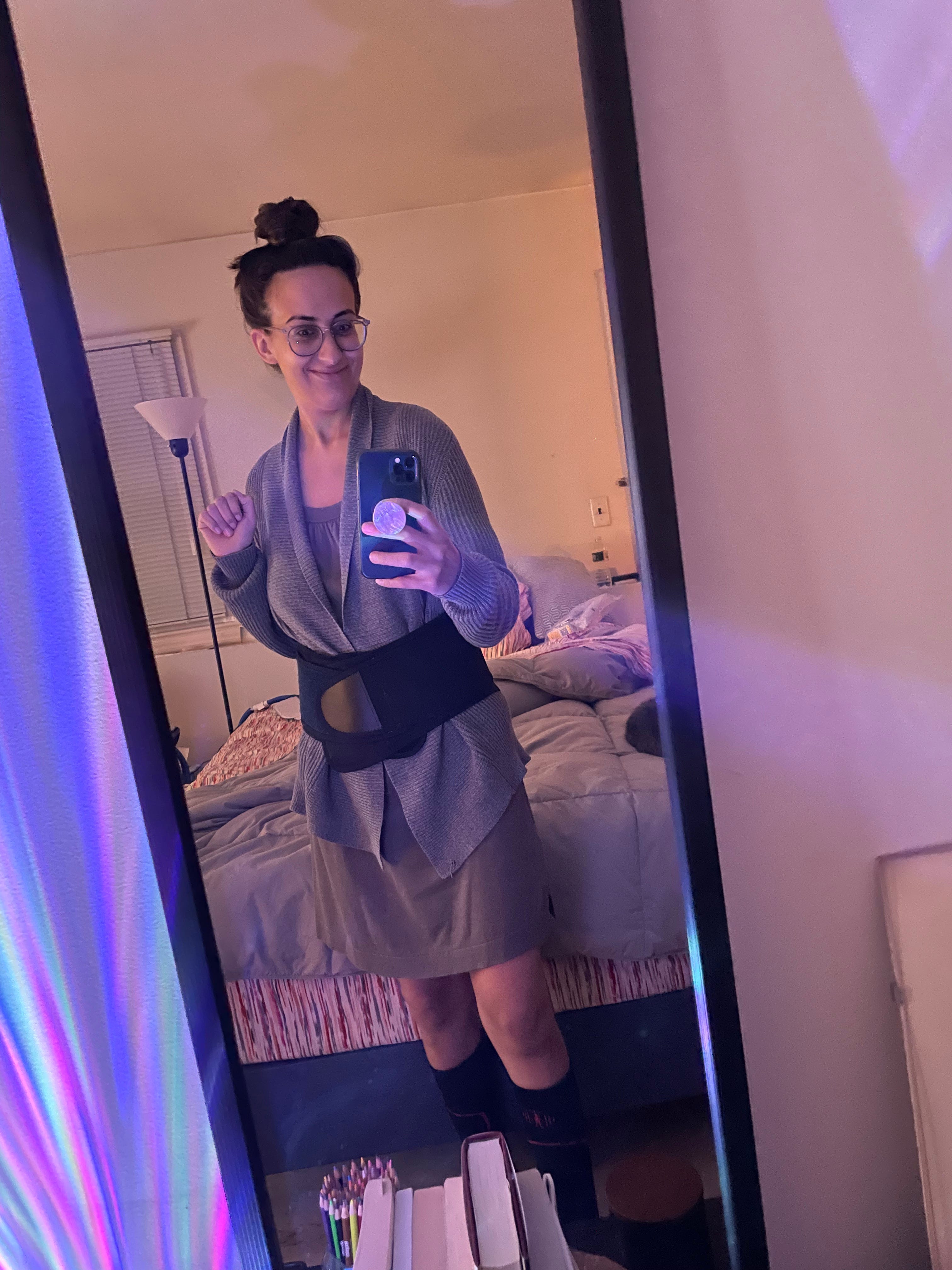
Going to physical therapy three times a week, at thirty-four years old with my dad driving me because my legs weren’t strong enough, hobbling from the car to the facility’s door that I struggled to open with my rose gold cane supporting my weight and back brace wrapped tight around me, I stared everyone down who dared to examine me visually.
Worry about yourself.
One month into recovery, during the New Year holiday week, the staff rotated so everyone got some time off while still staying open every day. A technician in graduate school helped me throughout most of the day who I’d met but hadn’t interacted with much before then. As he filled out my paperwork usually done by the receptionist, I realized the skin on his hands appeared cracked and red, with painful-looking flakes and patches.
Psoriasis, I said to myself, pleased with my ability to self-diagnose.
As my session went on, I considered how uncomfortable he must feel using his hands with them appearing that way. I thought about he might treat the condition. I wondered about how psoriasis affected one’s social life.
Off of social media and making an effort to be present while I healed from the surgery instead of constantly comparing myself to the people working and creating families around me, I ruminated on and on for my entire treatment.
When I checked out, the same technician completed my daily form.
As he reviewed his work, the thought finally occurred to me, He probably feels worse for me than I do for him. I’m the one who’s here, with a cane and back brace, with my father driving me, unable to work. His hands will be better in a few days. We don’t know if I’ll ever get better.
While I stood outside waiting for my Dad to pull around, a woman I’d never met before passing by on the busy city street looked at me, smiled and said “Hi,” and then paused.
I realized with my cane, red glasses, face mask during Covid times, and hood wrapped around me, she thought I needed help.
Worry about yourself, I wanted to snarl at her.
But also, it warms my heart that she did it.
There is a way to get involved where we are codependent, attached to the outcome as a way to try and create “peace” in an ever-increasingly chaotic world. When we offer “help” in this way, what we are really offering is manipulation and control. The receiving person can always tell the energetic difference. That’s why it’s so important to take care of ourselves before we offer help to others. If we are unable to offer from a genuine place, if we are ruminative and obsessive, calculating and judgmental under the guise of pity, that is a sign that we are the ones who need to be on the receiving end. That is the sign that we need to pause, recalibrate, be available to receive assistance, community, and comfort, before concocting advice for others.